
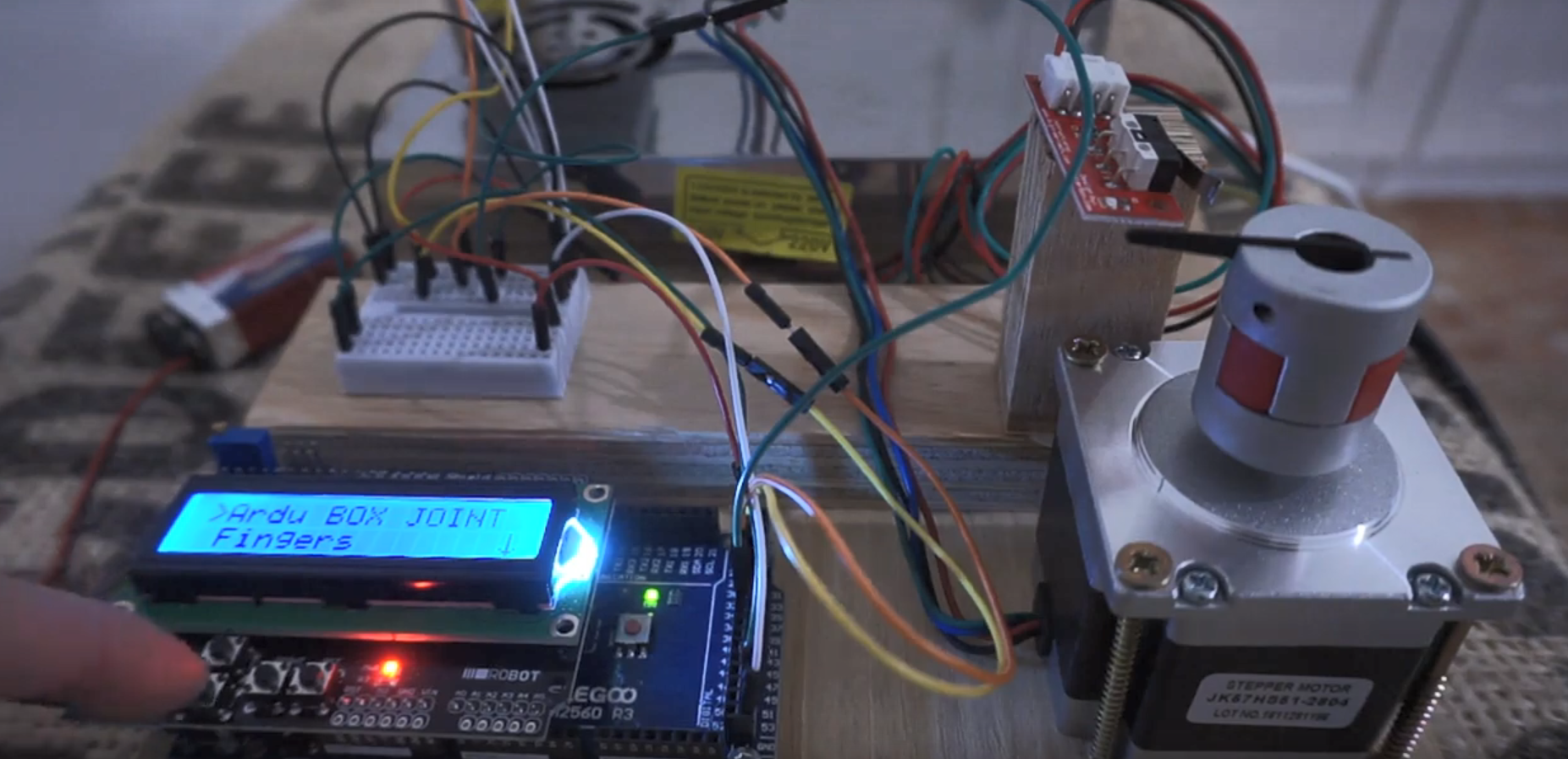
Today is the day of improvements. I finally had the chance to merge two different programs I’ve made for the LCD and stepper motor with my Arduino. Have a look at the video and if you want there’s the link to my GitHub page where you can find the Arduino code. Otherwise you can have a look at it below but keep in mind that even though that program is working this is not going to be the final release because I have to test it with the hardware that I am designing during these days. If you want to see how I am going to build the finger jointer sled, please have a look here.
Hope you’ll enjoy it!
/***************************************************************************************
Name : Ardu Box Jointer
Author : Max MakeVerse
Created : 19/01/2019
Last Modified: 08/02/2019
Version : 1.0
***************************************************************************************/
// THINGS TO DO
// 1) adjust the fingers menu
// 2)
// -----------------------------------------------------------------------------------------------------------------------------------------------------
// Stepping variables
// -----------------------------------------------------------------------------------------------------------------------------------------------------
const int STEP_PIN = 30; // clk+
const int Enable_PIN = 32; // en+
const int DIR_PIN = 34; //cw+
const int inLed = 13;
const int lSwitch = 53;
int velocity; // this is set by the user and serves to calculate the following variable.
// value from 1 to 10 then the corresponding actual value is calculated
int homingVelocity = 0;
int accelRate; // value from 1 to 10 then the corresponding actual value is calculated
int homingAccel = 1;
int curPosition = 0;
int minStepDelay = 100; // max velocity of the stepper motor
int maxMovingStepDelay = 2500; // min velocity of the stepper motor
int minAccelCycles = 20; //
int maxAccelCycles = 500; //
int mmPerRev = 5; // 5 mm x
// -----------------------------------------------------------------------------------------------------------------------------------------------------
// Finger joint variables
// -----------------------------------------------------------------------------------------------------------------------------------------------------
int numberOfFingers = 10;
float kerf = 3.5;
int lumberWidth = 150;
int Overlap = 1;
float tolerance = 0.01; // this is the tolerance between the plain slot and the cut slot
float avanzamentoStd = kerf - Overlap;
float dimSlot = (lumberWidth - tolerance * numberOfFingers)/(numberOfFingers*2);
float slotTolerance = dimSlot + tolerance;
int NumeroCicliInSlot = slotTolerance / (kerf - Overlap);
long jobTimer;
// -----------------------------------------------------------------------------------------------------------------------------------------------------
// Creates 3 CUSTOM CHARACTERS for the menu display
// -----------------------------------------------------------------------------------------------------------------------------------------------------
byte downArrow[8] = { // 8 is the number of arrays
0b00100, // * // you can make your own custom characters at https://maxpromer.github.io/LCD-Character-Creator/
0b00100, // *
0b00100, // *
0b00100, // *
0b00100, // *
0b10101, // * * *
0b01110, // ***
0b00100 // *
};
byte upArrow[8] = {
0b00100, // *
0b01110, // ***
0b10101, // * * *
0b00100, // *
0b00100, // *
0b00100, // *
0b00100, // *
0b00100 // *
};
byte menuCursor[8] = {
B01000, // *
B00100, // *
B00010, // *
B00001, // *
B00010, // *
B00100, // *
B01000, // *
B00000 //
};
// this is a special character to display the status of the homing procedure
byte loadingCursor[8] = {
B01010,
B10101,
B01010,
B10101,
B01010,
B10101,
B01010,
B10101
};
// -----------------------------------------------------------------------------------------------------------------------------------------------------
// include the LCD libraries
// -----------------------------------------------------------------------------------------------------------------------------------------------------
#include <Wire.h>
#include <LiquidCrystal.h>
// Setting the LCD shields pins
LiquidCrystal lcd(8, 9, 4, 5, 6, 7);
// Navigation button variables
int readKey;
// Menu control variables
String menuItems[] = {"Ardu BOX JOINT", "Fingers", "Kerf", "Width", "Overlap", "Tolerance", "Results", "Home procedure", "Start Cut"};
int menuPage = 0;
int maxMenuPages = 7; // round(((sizeof(menuItems) / sizeof(String)) / 2) + .5);
int cursorPosition = 0;
// Stepper Motor Travel Variables
long TravelX; // this is used to store the X value
long maxTravelX = 1350; // Default maximum travel in [mm]
long sprX = 400; // SPR: steps per revolution: 400 = half stepping
long pitchX = 40; // Pitch [mm/revolution)
float mmToStepX = sprX / pitchX; // Multiplier to convert mm to steps: spr / pitch
int move_finished = 1; // used to check if the movement is completed
long initial_homing = -1; // this is the initial movement of the stepper used during the homing procedure
// where the minus symbol represents the direction of the rotation (translation)
int homing = 0; // if the homing procedure has been done the value will be 1 and the menu will skip to
// ask agai if you want to home. You'll be able just to press left and go back to the main
// page of the menu.
// -----------------------------------------------------------------------------------------------------------------------------------------------------
// -----------------------------------------------------------------------------------------------------------------------------------------------------
void setup() {
// Initializes serial communication
Serial.begin(9600);
pinMode(STEP_PIN, OUTPUT);
pinMode(Enable_PIN, OUTPUT);
pinMode(DIR_PIN, OUTPUT);
pinMode(inLed, OUTPUT);
pinMode(lSwitch, INPUT);
digitalWrite(STEP_PIN, LOW);
digitalWrite(Enable_PIN, HIGH); //When device turned on the motor has NOT holding power. The holdig power is given after homing
// -----------------------------------------------------------------------------------
// call HOMING PROCEDURE function
// -----------------------------------------------------------------------------------
//homingProcedure(); // this function initializes the homing procedure once the Arduino board is powered on
// Initializes and clears the LCD screen
lcd.begin(16, 2);
lcd.clear();
// Creates the byte for the 3 custom characters
lcd.createChar(0, menuCursor);
lcd.createChar(1, upArrow);
lcd.createChar(2, downArrow);
lcd.createChar(3, loadingCursor);
}
void loop() {
mainMenuDraw();
drawCursor();
operateMainMenu();
float avanzamentoStd = kerf - Overlap;
int dimSlot = (lumberWidth - tolerance * numberOfFingers)/(numberOfFingers*2);
}
void mainMenuDraw() {
// -----------------------------------------------------------------------------------------------------------------------------------------------------
// This function will generate the 2 menu items that can fit on the screen. They will change as you scroll through your menu.
// Up and down arrows will indicate your current menu position.
// -----------------------------------------------------------------------------------------------------------------------------------------------------
Serial.print(menuPage);
printOnLCDA(menuItems[menuPage], menuItems[menuPage + 1]);
// lcd.clear();
// lcd.setCursor(1, 0);
// lcd.print(menuItems[menuPage]);
// lcd.setCursor(1, 1);
// lcd.print(menuItems[menuPage + 1]);
if (menuPage == 0) {
lcd.setCursor(15, 1);
lcd.write(byte(2));
} else if (menuPage > 0 and menuPage < maxMenuPages) {
lcd.setCursor(15, 1);
lcd.write(byte(2));
lcd.setCursor(15, 0);
lcd.write(byte(1));
} else if (menuPage == maxMenuPages) {
lcd.setCursor(15, 0);
lcd.write(byte(1));
}
}
void drawCursor() {
// When called, this function will erase the current cursor and redraw it based on the cursorPosition and menuPage variables.
for (int x = 0; x < 2; x++) { // Erases current cursor
lcd.setCursor(0, x);
lcd.print(" ");
}
// The menu is set up to be progressive (menuPage 0 = Item 1 & Item 2, menuPage 1 = Item 2 & Item 3, menuPage 2 = Item 3 & Item 4), so
// in order to determine where the cursor should be you need to see if you are at an odd or even menu page and an odd or even cursor position.
if (menuPage % 2 == 0) {
if (cursorPosition % 2 == 0) { // If the menu page is even and the cursor position is even that means the cursor should be on line 1
lcd.setCursor(0, 0);
lcd.write(byte(0));
}
if (cursorPosition % 2 != 0) { // If the menu page is even and the cursor position is odd that means the cursor should be on line 2
lcd.setCursor(0, 1);
lcd.write(byte(0));
}
}
if (menuPage % 2 != 0) {
if (cursorPosition % 2 == 0) { // If the menu page is odd and the cursor position is even that means the cursor should be on line 2
lcd.setCursor(0, 1);
lcd.write(byte(0));
}
if (cursorPosition % 2 != 0) { // If the menu page is odd and the cursor position is odd that means the cursor should be on line 1
lcd.setCursor(0, 0);
lcd.write(byte(0));
}
}
}
void operateMainMenu() {
int activeButton = 0;
while (activeButton == 0) {
int button;
readKey = analogRead(0);
if (readKey < 790) {
delay(100);
readKey = analogRead(0);
}
button = evaluateButton(readKey);
switch (button) {
case 0: // When button returns as 0 there is no action taken
break;
case 1: // This case will execute if the "forward" button is pressed
button = 0;
switch (cursorPosition) { // The case that is selected here is dependent on which menu page you are on and where the cursor is.
case 0:
menuItem1(); // not used as the first line is used for the logo
break;
case 1:
menuItem2(); // number of fingers setting
break;
case 2:
menuItem3(); // kerf settings
break;
case 3:
menuItem4(); // lumber width settings
break;
case 4:
menuItem5(); // overlap setting
break;
case 5:
menuItem6(); // tolerance setting
break;
case 6:
menuItem7(); // homing procedure
break;
case 7:
menuItem8(); // start cutting procedure sub menu
break;
case 8: // not used
menuItem9();
break;
case 9: // not used
//menuItem10();
break;
}
activeButton = 1;
mainMenuDraw();
drawCursor();
break;
case 2:
button = 0;
if (menuPage == 0) {
cursorPosition = cursorPosition - 1;
cursorPosition = constrain(cursorPosition, 0, ((sizeof(menuItems) / sizeof(String)) - 1));
}
if (menuPage % 2 == 0 and cursorPosition % 2 == 0) {
menuPage = menuPage - 1;
menuPage = constrain(menuPage, 0, maxMenuPages);
}
if (menuPage % 2 != 0 and cursorPosition % 2 != 0) {
menuPage = menuPage - 1;
menuPage = constrain(menuPage, 0, maxMenuPages);
}
cursorPosition = cursorPosition - 1;
cursorPosition = constrain(cursorPosition, 0, ((sizeof(menuItems) / sizeof(String)) - 1));
mainMenuDraw();
drawCursor();
activeButton = 1;
break;
case 3:
button = 0;
if (menuPage % 2 == 0 and cursorPosition % 2 != 0) {
menuPage = menuPage + 1;
menuPage = constrain(menuPage, 0, maxMenuPages);
}
if (menuPage % 2 != 0 and cursorPosition % 2 == 0) {
menuPage = menuPage + 1;
menuPage = constrain(menuPage, 0, maxMenuPages);
}
cursorPosition = cursorPosition + 1;
cursorPosition = constrain(cursorPosition, 0, ((sizeof(menuItems) / sizeof(String)) - 1));
mainMenuDraw();
drawCursor();
activeButton = 1;
break;
}
}
}
int evaluateButton(int x) {
// This function is called whenever a button press is evaluated. The LCD shield works by observing a voltage drop across the buttons all hooked up to A0.
int result = 0;
if (x < 50) {
result = 1; // right
} else if (x < 195) {
result = 2; // up
} else if (x < 380) {
result = 3; // down
} else if (x < 790) {
result = 4; // left
}
return result;
}
void drawInstructions() {
// If there are common usage instructions on more than 1 of your menu items you can call this function from the sub
// menus to make things a little more simplified. If you don't have common instructions or verbage on multiple menus
// I would just delete this void. You must also delete the drawInstructions()function calls from your sub menu functions.
lcd.setCursor(0, 1); // Set cursor to the bottom line
lcd.print("Use ");
lcd.print(byte(1)); // Up arrow
lcd.print("/");
lcd.print(byte(2)); // Down arrow
lcd.print(" buttons");
}
void eraseLine(int row){
lcd.setCursor(0, row); // Start of row
lcd.print(" "); // 20 spaces
lcd.setCursor(0, row); // Start of row
}
void menuItem1() { // Function executes when you select the 2nd item from main menu
int activeButton = 0;
lcd.clear();
}
void menuItem2() { // Function executes when you select the 2nd item from main menu
int activeButton = 0;
printOnLCD("Fingers Needed:", numberOfFingers);
// lcd.clear();
// lcd.setCursor(0, 0);
// lcd.print("Fingers Needed:");
// lcd.setCursor(0, 1);
// lcd.print(numberOfFingers);
while (activeButton == 0) {
int button;
readKey = analogRead(0);
lcd.cursor(); // Turn on blinking cursor
lcd.blink(); // Turn on blinking cursor
lcd.noBlink(); // Turn off blinking curosr
lcd.noCursor(); // Turn off blinking curosr
if (readKey < 790) {
delay(100);
readKey = analogRead(0);
}
button = evaluateButton(readKey);
switch (button) {
case 4: // This case will execute if the "back" button is pressed
button = 0;
activeButton = 1;
break;
case 2: // This case will execute if the "up" button is pressed
numberOfFingers++;
eraseLine(1); // Erases line 1
lcd.print(numberOfFingers);
break;
case 3: // This case will execute if the "down" button is pressed
numberOfFingers--;
eraseLine(1); // Erases line 1
lcd.print(numberOfFingers);
break;
}
}
}
void menuItem3() { // Function executes when you select the 3rd item from main menu
int activeButton = 0;
lcd.clear();
lcd.setCursor(0, 0);
lcd.print("Kerf size:");
lcd.setCursor(0,1);
lcd.print(kerf);
while (activeButton == 0) {
int button;
readKey = analogRead(0);
if (readKey < 790) {
delay(100);
readKey = analogRead(0);
}
button = evaluateButton(readKey);
switch (button) {
case 4: // This case will execute if the "back" button is pressed
button = 0;
activeButton = 1;
break;
case 2: // This case will execute if the "up" button is pressed
kerf = kerf + 0.05;
eraseLine(1); // Erases line 1
lcd.print(kerf);
break;
case 3: // This case will execute if the "down" button is pressed
kerf = kerf - 0.05;
eraseLine(1); // Erases line 1
lcd.print(kerf);
break;
}
}
}
void menuItem4() { // Function executes when you select the 3rd item from main menu
int activeButton = 0;
lcd.clear();
lcd.setCursor(0, 0);
lcd.print("Lumber width:");
lcd.setCursor(0,1);
lcd.print(lumberWidth);
while (activeButton == 0) {
int button;
readKey = analogRead(0);
if (readKey < 790) {
delay(100);
readKey = analogRead(0);
}
button = evaluateButton(readKey);
switch (button) {
case 4: // This case will execute if the "back" button is pressed
button = 0;
activeButton = 1;
break;
case 2: // This case will execute if the "up" button is pressed
lumberWidth = lumberWidth + 10;
eraseLine(1); // Erases line 1
lcd.print(lumberWidth);
break;
case 3: // This case will execute if the "down" button is pressed
lumberWidth = lumberWidth - 10;
eraseLine(1); // Erases line 1
lcd.print(lumberWidth);
break;
}
}
}
void menuItem5() { // Function executes when you select the 5th item from main menu
int activeButton = 0;
lcd.clear();
lcd.setCursor(0, 0);
lcd.print("Cut Overlap:");
lcd.setCursor(0,1);
lcd.print(Overlap);
while (activeButton == 0) {
int button;
readKey = analogRead(0);
if (readKey < 790) {
delay(100);
readKey = analogRead(0);
}
button = evaluateButton(readKey);
switch (button) {
case 4: // This case will execute if the "back" button is pressed
button = 0;
activeButton = 1;
break;
case 2: // This case will execute if the "up" button is pressed
Overlap++;
eraseLine(1); // Erases line 1
lcd.print(Overlap);
break;
case 3: // This case will execute if the "down" button is pressed
Overlap--;
eraseLine(1); // Erases line 1
lcd.print(Overlap);
break;
}
}
}
void menuItem6() { // Function executes when you select the 6th item from main menu
int activeButton = 0;
lcd.clear();
lcd.setCursor(0, 0);
lcd.print("Tolerance:");
lcd.setCursor(0,1);
lcd.print(tolerance);
while (activeButton == 0) {
int button;
readKey = analogRead(0);
if (readKey < 790) {
delay(100);
readKey = analogRead(0);
}
button = evaluateButton(readKey);
switch (button) {
case 4: // This case will execute if the "back" button is pressed
button = 0;
activeButton = 1;
break;
case 2: // This case will execute if the "up" button is pressed
tolerance = tolerance + 0.01;
eraseLine(1); // Erases line 1
lcd.print(tolerance);
break;
case 3: // This case will execute if the "down" button is pressed
tolerance = tolerance - 0.01;
eraseLine(1); // Erases line 1
lcd.print(tolerance);
break;
}
}
}
void menuItem7() { // This sub menu is useful to display the results of the settings
int activeButton = 0;
lcd.clear();
// calculate again the main parameters
avanzamentoStd = kerf - Overlap;
dimSlot = (lumberWidth - tolerance * numberOfFingers)/(numberOfFingers*2);
slotTolerance = dimSlot + tolerance;
NumeroCicliInSlot = slotTolerance / (kerf - Overlap);
lcd.setCursor(0,0);
lcd.print(slotTolerance);
lcd.setCursor(0,1);
lcd.print(NumeroCicliInSlot);
while (activeButton == 0) {
int button;
readKey = analogRead(0);
if (readKey < 790) {
delay(100);
readKey = analogRead(0);
}
button = evaluateButton(readKey);
switch (button) {
case 4: // This case will execute if the "back" button is pressed
button = 0;
activeButton = 1;
break;
}
}
}
void menuItem8() { // this submenu calls the HOMING PROCEDURE function
int activeButton = 0;
if (homing == 1){
homing = 0;
// printOnLCD(alpha, beta);
printOnLCD("Homing done","");
while (activeButton == 0) {
int button;
readKey = analogRead(0);
if (readKey < 790) {
delay(100);
readKey = analogRead(0);
}
button = evaluateButton(readKey);
switch (button) {
case 4: // back button is pressed and go back to the main menu
button = 0;
activeButton = 1;
break;
}
}
}else if (homing == 0){
String yn = "No";
printOnLCD("Start Homing?", yn);
// Reading the button value in order to switch from yes to no and viceversa
while (activeButton == 0) {
int button;
readKey = analogRead(0);
if (readKey < 790) {
delay(100);
readKey = analogRead(0);
}
// Button evaluation function
button = evaluateButton(readKey);
switch (button) {
case 1: // Right button is pressed
if (yn == "Yes"){
homingPro(); // If yes the HOMING function is called
}else if (yn == "No") {
button = 0; // If no, acts same as if the left button was called
activeButton = 1;
}
break;
case 2: // Up button
if (yn == "No"){
yn = "Yes";
eraseLine(1); // Erases line 1
lcd.print(yn);
}else if (yn == "Yes") {
yn = "No";
eraseLine(1); // Erases line 1
lcd.print(yn);
}
break;
case 3: // Down button
if (yn == "No"){
yn = "Yes";
eraseLine(1); // Erases line 1
lcd.print(yn);
}else if (yn == "Yes") {
yn = "No";
eraseLine(1); // Erases line 1
lcd.print(yn);
}
break;
case 4: // Left button, go back
button = 0;
activeButton = 1;
break;
}
}
}
}
void menuItem9() { // Function executes when you select the 8th item from main menu
int activeButton = 0;
printOnLCD("Cutting procedure", "- - - - - -");
// drawInstructions(); // could be useful
// if the right button is pressed, then start the cutting procedure
// new submenu with special instructions and button functionalities
cuttingProcedure();
printOnLCD("Cutting Done!", "- - - - - -");
while (activeButton == 0) {
int button;
readKey = analogRead(0);
if (readKey < 790) {
delay(100);
readKey = analogRead(0);
}
button = evaluateButton(readKey);
switch (button) {
case 4: // This case will execute if the "back" button is pressed
button = 0;
activeButton = 1;
break;
}
}
}
void cuttingProcedure() {
eraseLine(1);
eraseLine(2);
jobTimer = millis();
// -------------------------------------------------------------------------------
// calculate again the parameters
// -------------------------------------------------------------------------------
avanzamentoStd = kerf - Overlap;
dimSlot = (lumberWidth - tolerance * numberOfFingers)/(numberOfFingers*2);
slotTolerance = dimSlot + tolerance;
NumeroCicliInSlot = slotTolerance / (kerf - Overlap);
float initial_position = dimSlot; // First cut has to be done after one finger
// float finalCut = pinWidth - k; // The final cut has its right hand edge on the right hand side of the slot
// int c = ceil(pinWidth / k); // Number of cuts required per slot
// float inc = finalCut / (c - 1); // Increment to be added for each cut - except the last
printOnLCD("Place the piece", "then press right-");
int activeButton = 0;
while (activeButton == 0) {
int button;
readKey = analogRead(0);
if (readKey < 790) {
delay(100);
readKey = analogRead(0);
}
button = evaluateButton(readKey);
switch (button) {
case 1: // Right button is pressed
activeButton = 1; // Proceed to next step
break;
case 4: // Left button, abort the cutting procedure
button = 0;
activeButton = 1;
// go back function or reset has to be added
break;
}
}
printOnLCD("Adjust with motor", "then press right-");
activeButton = 0;
while (activeButton == 0) {
int button;
readKey = analogRead(0);
if (readKey < 790) {
delay(100);
readKey = analogRead(0);
}
button = evaluateButton(readKey);
switch (button) {
case 1: // Right button is pressed
activeButton = 1; // Proceed to next step
break;
case 2: // Up button
// increment position of the motor
// tbd external function to be used
moveBy(50,5);
break;
case 3: // Down button
// decrement position of the motor
// tbd external function to be used
moveBy(-50,5);
break;
}
}
// tbd store the position using some new variable
displayNextStep("Turn on the saw", "then press right-");
//stepperMovement(initial_position);
for (int i = 0; i < numberOfFingers; i++) { // cycle to be performed for each finger
}
displayNextStep("Cutting done", "press right");
}
void cutSlot() {
// 1) first movement
// stepperMovement(initial_position);
displayNextStep("left cut", "press right");
cutSlot();
// calculate last position
// stepperMovement(last_position);
displayNextStep("right cut", "press right");
cutSlot();
// calculate initial_position + saw kurf - overhang
// stepperMovement(set_position);
for (int z = 0; z = 10; z++) {
displayNextStep("inner cuts", "press right");
cutSlot();
// calculate set_position + saw kurf - overhang
// stepperMovement(set_position);
}
}
void printOnLCD(String alpha, String beta) {
lcd.clear();
lcd.setCursor(0, 0);
lcd.print(alpha);
lcd.setCursor(0, 1);
lcd.print(beta);
}
void printOnLCDA(String alpha, String beta) {
lcd.clear();
lcd.setCursor(1, 0);
lcd.print(alpha);
lcd.setCursor(1, 1);
lcd.print(beta);
}
void displayNextStep(String alpha, String beta) {
printOnLCD(alpha, beta);
int activeButton = 0;
while (activeButton == 0) {
int button;
readKey = analogRead(0);
if (readKey < 790) {
delay(100);
readKey = analogRead(0);
}
button = evaluateButton(readKey);
switch (button) {
case 1: // Right button is pressed
activeButton = 1; // Proceed to next step
break;
}
}
}
// while (activeButton == 0) {
// int button;
// readKey = analogRead(0);
// if (readKey < 790) {
// delay(100);
// readKey = analogRead(0);
// }
// button = evaluateButton(readKey);
// switch (button) {
// case 1: // Right button is pressed
//
// break;
// case 2: // Up button
//
// break;
// case 3: // Down button
//
// break;
// case 4: // Left button, go back
//
// break;
// }
// }
void moveUntil(int x, int vel){
// absolute stepping
int stepsToGo;
stepsToGo = x - curPosition;
moveBy(stepsToGo, vel);
curPosition = x;
}
void stepping(int del){
digitalWrite(STEP_PIN, HIGH);
digitalWrite(inLed, HIGH);
delayMicroseconds(del); // holding for some microseconds
digitalWrite(STEP_PIN, LOW);
digitalWrite(inLed, LOW);
delayMicroseconds(del);
}
void moveBy(long steps, int vel) {
digitalWrite(Enable_PIN, LOW);
// relative stepping
int stpDelay;
if (steps >= 0){
digitalWrite(Enable_PIN, LOW);
digitalWrite(DIR_PIN, LOW);
} else {
digitalWrite(Enable_PIN, LOW);
digitalWrite(DIR_PIN, HIGH);
steps = abs(steps);
}
stpDelay = map((11 - vel), 1, 10, minStepDelay, maxMovingStepDelay);
int accelCycles = 300;
int del = maxMovingStepDelay;
int growRate =(maxMovingStepDelay-stpDelay)/accelCycles;
if (steps < (2* accelCycles)){
for (int i = 0; i < steps; i++) {
stepping(maxMovingStepDelay);
}
}else{
stpDelay = map((11 - vel), 1, 10, minStepDelay, maxMovingStepDelay);
int accelCycles = 300;
int del = maxMovingStepDelay;
int growRate =(maxMovingStepDelay-stpDelay)/accelCycles;
for (int i = 0; i < steps; i++) {
if (i <= accelCycles) {
del = del - growRate;
if (del < stpDelay){
del = stpDelay;
}
stepping(del);
}else if ((steps - i) <= accelCycles) {
del = del + growRate;
if (del < stpDelay){
del = stpDelay;
}
stepping(del);
} else {
stepping(stpDelay);
}
}
}
curPosition = curPosition + steps;
}
void homingPro() {
while (digitalRead(lSwitch)) { // while the limit switch is not pressed the routine goes
moveBy(-1, homingVelocity); // moving backwards very slowly in order to find the limit switch
}
delay(1000);
while (!digitalRead(lSwitch)) { // while the limit switch is not pressed the routine goes
moveBy(1, homingVelocity); // moving backwards very slowly in order to find the limit switch
}
moveBy(150, homingVelocity);
curPosition = 0;
delay(2000);
}
Cheers
Max
 MAK-E-VERSE